


Buying a Caravan – How to Choose and Start Your RV Adventure
Buying your first caravan is an exciting step into the world of travel freedom and outdoor living. But if you’ve never owned one before, it can also feel overwhelming — especially when faced with dozens of models, layouts, and prices. This guide will help you make a smart choice and start your adventure on solid ground.
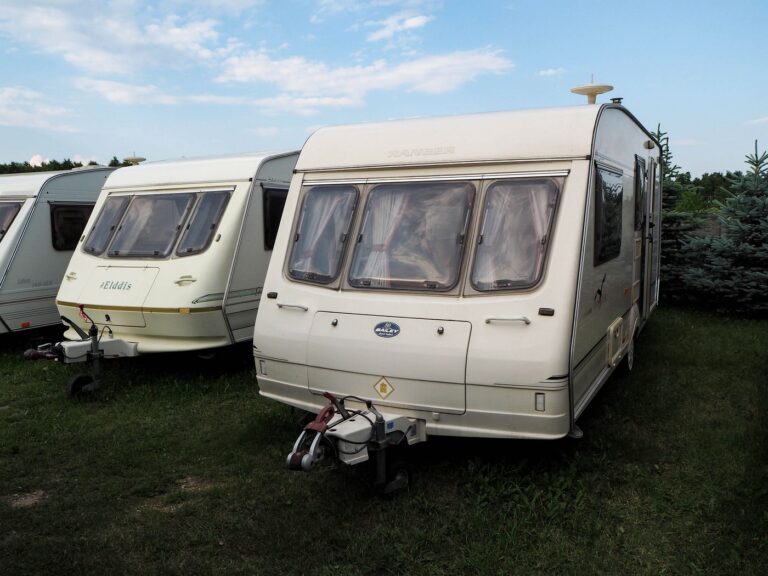
Why Buy a Caravan?
Caravanning isn’t just a way to spend time outdoors — it’s also a fantastic opportunity to discover new places and create unforgettable memories with family and friends. Among the many accommodation options available while traveling, a caravan stands out as a comfortable, flexible, and budget-friendly choice. So why should you consider investing in a caravan? Here are a few good reasons:
Freedom and Independence
A caravan gives you the freedom to travel on your own schedule, stop wherever you like, and explore places far beyond hotels and tourist zones. You decide when to rest, where to sleep, and how long to stay. It’s true independence on wheels.
Home on the Road
A caravan is not just a vehicle — it’s your mobile home. You can cook, sleep, work, and relax anywhere you want. Many travelers also appreciate the sense of coziness that only a small, private space can offer.
Saving money on longer trips
In the long run, a caravan can be a more affordable accommodation option than hotels or apartments — especially during peak season. You can save not only on lodging costs but also by cooking your own meals and taking advantage of free or low-cost camping spots.
Flexibility and independence
Owning your own caravan gives you full control over your travels. You don’t have to book accommodations far in advance or worry about availability. You’re free and flexible — able to change your route spontaneously and stop wherever you like.
Quality time with nature and people
Camping is a perfect way to enjoy the great outdoors — spending your days picnicking and your evenings relaxing by the campfire. Whether you’re a beach lover, a mountain fan, or a lake person, a travel trailer lets you go pretty much anywhere you want! The only real limitation is off-road terrain — that’s where a 4x4 takes the lead. 🙂
How to choose your first travel trailer
If you’re just getting started with caravanning, you don’t need a luxury trailer. The most important thing is that it’s watertight, dry, and mechanically sound. Look for models with a simple layout — you can always customize them later to fit your needs. Pay attention to the gross weight (GVWR), the interior layout, and how easy it is to find replacement parts.
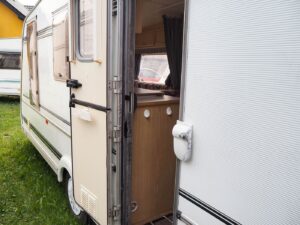
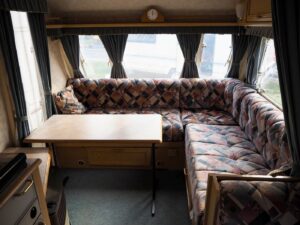
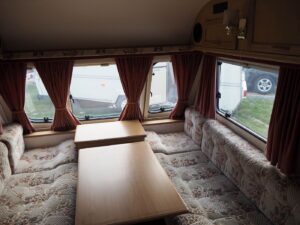
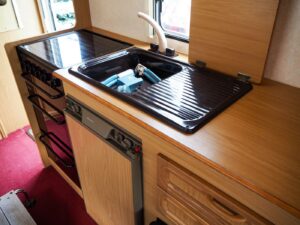
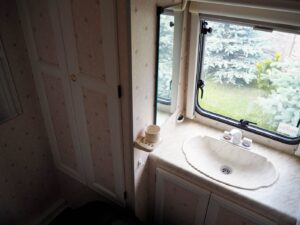
USED TRAVEL TRAILER BUYER’S CHECKLIST
1. Exterior and body condition
Roof and upper components
Check for cracks or repairs around skylights, vents, and the antenna.
Look for standing water or bulging areas on the roof — these can indicate leaks.
Examine all sealant lines; fresh, uneven “globs” of sealant with no proof of service = red flag.
Walls and exterior panels
Inspect for dents, holes, patched areas, or filler marks (like bondo).
Watch for delamination or “banana” bulges on the sides — this often means the trim has lost its seal.
Check seals and molding strips — if they’re dry, brittle, or cracked, there’s a high risk of leaks.
Undercarriage and floor
Frame should be straight and free from cracks. Surface rust is fine; deep corrosion is not.
Inspect the joint where the floor meets the wall — there should be no gaps or separation.
Look underneath the floor for dark spots, mold, or soft areas — these point to water damage.
2. Interior (moisture and woodwork)
Quick check
Smell test: musty odor = warning; smell of fresh paint or new carpet may mean someone’s masking damage.
Floors should feel solid everywhere — no “spongy” or soft spots.
Wall panels should be flat with no ripples or signs of delamination.
Windows and fittings
Windows should be intact — small scratches are fine, but no cracks.
Lift the seals and check underneath for dampness or mold.
Make sure window mechanisms, blinds, and mosquito nets work properly in every window.
Furniture
Cabinets and walls should be tightly fitted — no gaps or pulled screws.
Beds: check real size and test folding/unfolding to make sure it’s practical.
Upholstery and cushions: no signs of mold or heavy moisture. (Replacing a full set can be surprisingly expensive.)
3. Chassis and safety components
Tires: Check the DOT date — should be no older than 6 years. No cracks, dry rot, or flat spots; verify proper pressure.
Rims, bolts, spare tire, and jack
Hitch and stabilizer (AL-KO/Knott): No excessive play; ensure the locking mechanism works smoothly.
Overrun brake: Should engage and release smoothly with no jerking or stiffness.
Shock absorbers and rubber suspension parts: No leaks, cracks, or visible damage.
Electrical connector (7/13-pin): Test all trailer lights — brake, turn signals, and fog lights must work properly.
4. Utilities and appliances – three-source test
230 V
Outlets and 230V lighting work properly; the RCD (residual current device) trips and resets correctly.
Charger/transformer – the battery receives charging power when connected to 230V.
12 V
12V lighting, water pump, and control panels – all function correctly without 230V power connected.
Solar regulator (if installed) – charging properly and showing correct voltage output.
Gas system
Regulator (30 mbar) and hose are within date and show no leaks (check with soapy water).
Stove: all burners light and produce a steady flame.
Heater (Truma S/Combi/Webasto): starts up, blows warm air or vents properly, no exhaust smell.
Water heater (gas/230V): delivers hot water within 15–30 minutes.
Water system
Fresh and waste tanks are clean; check all joints and connections for leaks.
Pump (submersible or pressure type) starts and stops properly, no constant running noise.
Faucets with microswitches activate the pump and stop dripping when closed.
Toilet: test flush (manual or electric), inspect cassette and seals.
Absorption fridge (3-way)
Cools properly on 230V.
Cools on 12V (usually only while driving).
Cools on gas (steady flame, clean ventilation grilles).
5. Documents and compliance
Registration certificate / foreign documents with translations.
Vehicle card (if applicable).
Valid technical inspection (if required).
VIN and nameplate – match the documents.
GVWR / curb weight / payload – within your car’s towing limits and license category.
Bill of sale or invoice – seller’s data, ownership statement, no liens.
Service and damp check history (if available) – a big plus.
6. Additional equipment (adds real value)
Awning or canopy – check completeness, fabric condition, poles and brackets.
Battery and charger, MPPT regulator (if solar panels are installed).
Leveling ramps, corner steadies, crank handles, power cables, adapters.
Safety kit: CO detector, fire extinguisher (always a good sign).
7. Szybka kalkulacja po zakupie
Rejestracja 150–200 zł, OC od ~80 zł, przegląd 98 zł
Opony (jeśli stare) 400–700 zł komplet
Uszczelnienia/naprawy startowe 500–1500 zł (realnie)
Serwis osi/łożysk – warto zrobić od razu
Detektor CO + czujnik dymu – must-have, jeśli brak
Red Flag
No power, gas, or water “for some reason” → no full testing = no deal.
Soft walls or floor, clear smell of damp or mold.
Fresh paint or new carpets over large areas with no repair invoices.
Bent or twisted frame, severe structural rust, visible cracks.
Missing or unclear paperwork, unreadable or mismatched VIN.
Bonus: What to bring for the inspection
Ladder
Headlamp or flashlight
Mat or blanket (for checking the underbody)
Moisture meter
7/13-pin adapter
Soapy water spray (for gas leak tests)
230V circuit tester
List of questions about sealing work and service history
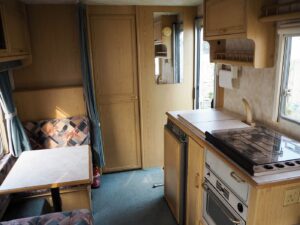
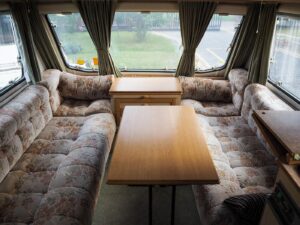
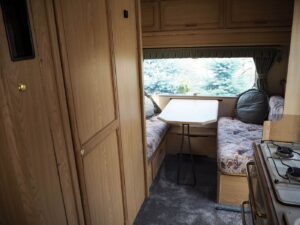
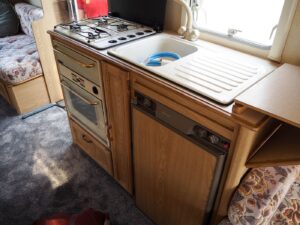
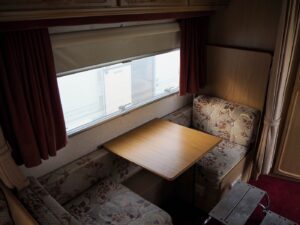
YOUTUBE
This is just the beginning of our story. Every screw, every new detail in our camper is a small step toward the dream of freedom.
If you’d like to see what life on the road really looks like — from the renovation process to our first trips — check out our YouTube channel.
MOST FREQUENTLY ASKED QUESTIONS
The most important things are watertightness and the condition of the floor. Check the roof, sealing strips, corners, and chassis. Always inspect the caravan while it’s connected to electricity and gas, so you can test the fridge, heating system, and water pump.
The most important things are watertightness and the condition of the floor. Check the roof, sealing strips, corners, and chassis. Always inspect the caravan while it’s connected to electricity and gas, so you can test the fridge, heating system, and water pump.
Registration costs around 180–200 PLN, and mandatory liability insurance (OC) starts at 80–100 PLN per year. If your caravan has an overrun brake system, you’ll need to renew the technical inspection annually — it costs about 100 PLN.
Yes, but only if the total permissible weight (GVWR) of the car and caravan together doesn’t exceed 3.5 tons. For heavier setups, you’ll need a B96 license (up to 4.25 tons) or a B+E license (over 4.25 tons).
You’ll need a bill of sale (or invoice), the vehicle registration document, a nameplate with the VIN number, and — if it’s imported — certified translations of all documents. It’s also a good idea to ask for proof of the most recent damp or seal inspection.
The best deals usually appear in fall and winter, when owners finish the season and decide to sell their caravans. In spring and summer, prices can rise by 20–30%, and the good listings often disappear within just a few days.
Check out our most popular articles
Popular searches: how to start RV life, buying a used camper trailer, how to buy a travel trailer, beginner’s guide to RVing, restoring an old camper, how much does a camper trailer cost, RV life in the USA, living on the road blog, vanlife vs RV life, travel trailer tips and advice